
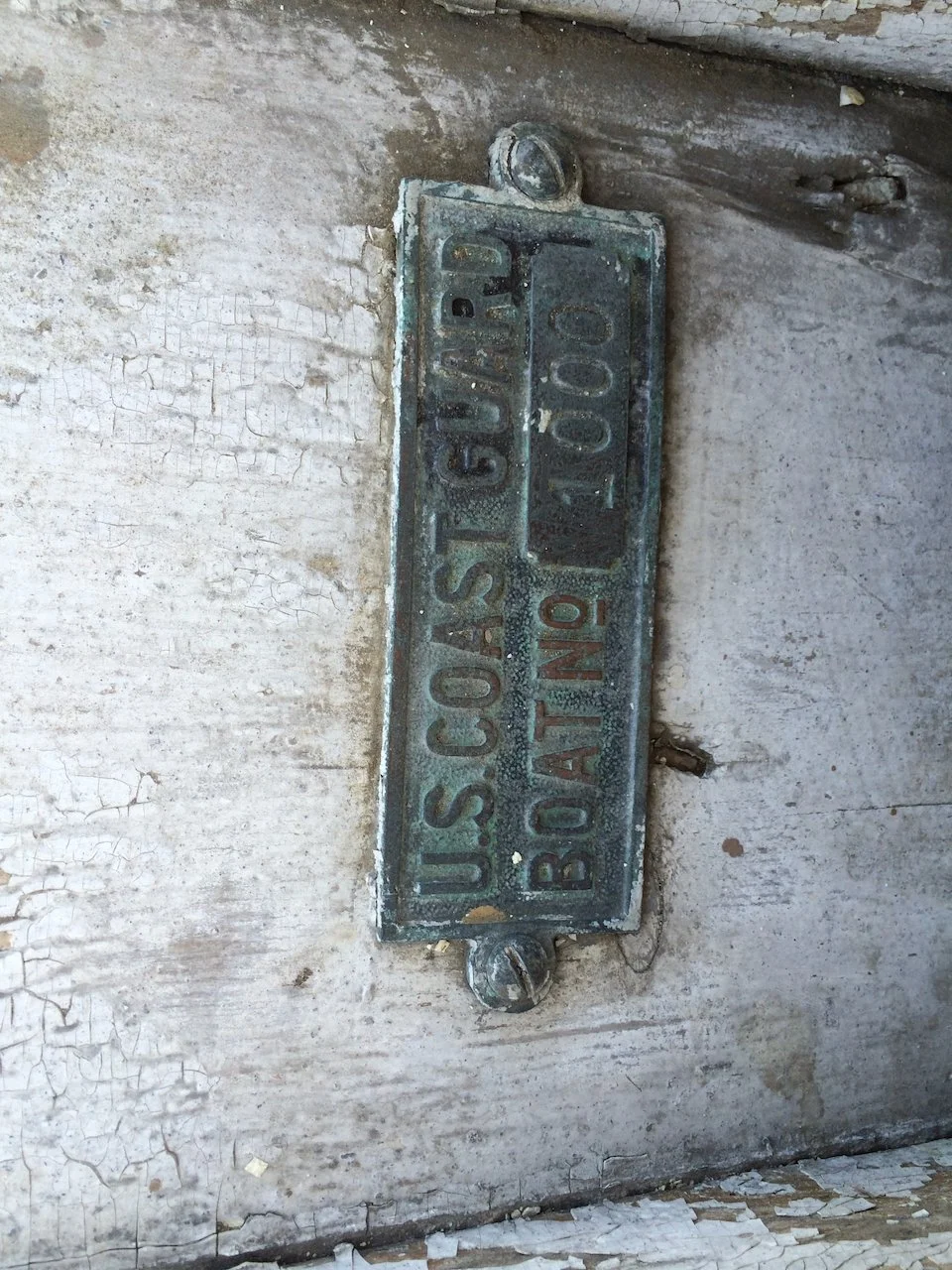
Amagansett Life Saving Station — U.S. Coast Guard Surf Boat No. 1000
The restoration of the Amagansett Life Saving Station involved advocacy rather than authorship. Working as a volunteer, and with the assistance of a United States congressman, I helped negotiate the transfer of a historic U.S. Coast Guard surf boat—Boat No. 1000—to provide the original Beebe surf boat that once defined the station’s working life. The effort was not a commissioned project, but a civic one: preserving the integrity of a public landmark through institutional coordination, patience, and persistence.
PRESERVATION
Preservation, for us, is not a style or a market category. It is a discipline—one that begins with restraint, careful observation, and respect for the intelligence embedded in existing structures. Whether a project involves relocation, reconstruction, adaptive reuse, or quiet repair, our work is guided by an ethic of continuity: understanding what already exists before deciding how, or whether, to intervene.
We approach preservation as a process rather than a product. It requires archival research, material literacy, and close collaboration with historians, institutions, craftspeople, and regulatory bodies. Just as importantly, it demands an attentiveness to atmosphere and memory—to the intangible qualities that give a place meaning beyond its physical components.
The projects referenced below represent moments when that commitment was central to the work. In each case, preservation was not an afterthought, but the framework through which design decisions were made. These projects are documented within our broader body of work and are linked here as points of reference rather than as a separate portfolio.
Charles Ives Studio — American Academy of Arts and Letters
The recreation of the Charles Ives Studio for the American Academy of Arts and Letters required an exacting level of material and cultural fidelity. The original studio—located on the ground floor of Ives’s modest home in Redding, Connecticut—was disassembled artifact by artifact and reassembled in New York City with the goal that the composer himself might recognize the room as his own. Every surface, object, and trace of use was documented and preserved, from the wear patterns on the floorboards to the contents of Ives’s pencil sharpener.
This work treated preservation as an act of translation rather than replication: relocating an interior not simply as an assemblage of parts, but as a living record of creative process, memory, and restraint. The studio now stands as both an artifact and an environment—one that conveys how Ives worked, thought, and composed during the final decades of his life.
Ellis Squires House — East Hampton, New York
The Ellis Squires House represents a long-term engagement with early domestic architecture on the East End of Long Island, where preservation often involves interpretation as much as repair. Dating to the late eighteenth century, the house reflects generations of adaptation layered onto an original timber-framed structure. Our work focused on understanding those layers—distinguishing what was essential from what was incidental—while stabilizing and preserving the building’s historic character.
In parallel with physical investigation, we undertook the research and documentation necessary to support the house’s inclusion on the National Register of Historic Places. Preservation here was not an attempt to return the house to a single moment in time, but to honor its cumulative history while ensuring its continued use and stewardship.
Pyrrhus Concer House — Southampton, New York
The Pyrrhus Concer House represents preservation as an act of historical recovery and public acknowledgment. Concer, a formerly enslaved man and a Revolutionary War veteran, lived in Southampton during the early nineteenth century, where his life and contributions were long underrepresented in the physical record of the village. Preserving the house associated with his life required research that extended beyond architecture—into genealogy, local archives, and the broader social history of the region.
Our work focused on stabilizing and interpreting the structure while supporting its role as a site of education and remembrance. Preservation here was inseparable from narrative: ensuring that the building could continue to speak not only about early construction on the East End, but about freedom, service, and the lives that shaped the community outside the traditional historical canon.
Hoyt-Barnum House — Stamford, Connecticut
The Hoyt-Barnum House stands among the oldest surviving dwellings in Connecticut, a rare example of late seventeenth-century domestic architecture preserved through centuries of use, neglect, and revival. Preservation of a structure of this age requires more than repair; it demands an understanding of incremental change—how a building absorbs generations of adaptation while retaining its essential form and meaning.
Our work engaged the house as a palimpsest, balancing stabilization and interpretation with respect for its accumulated history. Preservation here meant resisting the temptation to “correct” the past, instead allowing the building’s material evidence to remain legible as a record of early settlement, endurance, and continuity in New England’s built landscape.
Smith Taylor Cabin — Shelter Island, New York
The Smith Taylor Cabin represents preservation at its most elemental: a small, utilitarian structure whose value lies not in monumentality, but in survival. Modest in scale and material, the cabin speaks to patterns of seasonal life and labor on Shelter Island that are increasingly difficult to trace in the contemporary landscape.
Preserving a structure of this kind required restraint and care rather than transformation. The work focused on stabilizing the cabin and safeguarding its material integrity while allowing its simplicity to remain intact. Preservation here was an act of humility—recognizing that significance is not always tied to size or prominence, but often to the quiet persistence of ordinary buildings that once shaped everyday life.